First ever Microsoft Windows
What is the first ever Microsoft Windows released to the public?
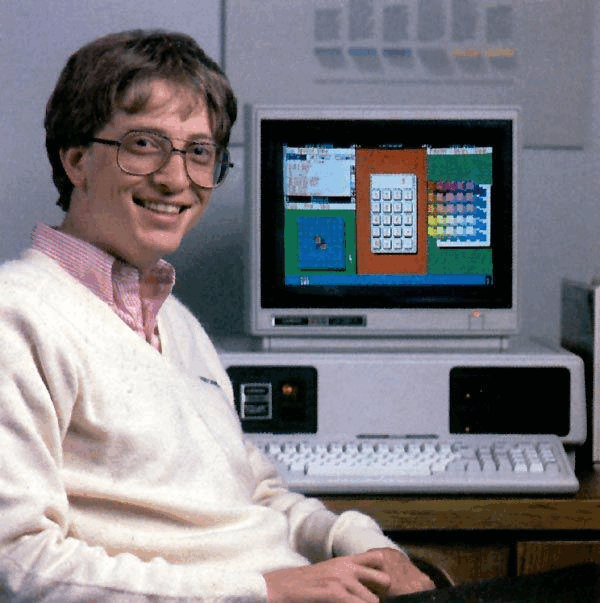
Bill Gates images with
Windows 1.0
|
Windows 1.0 is a graphics operating environment for personal computers, developed by Microsoft. Microsoft has partnered with Apple Computer to develop applications for the original Macintosh Apple 1984, the first mass-produced personal computer with graphical user interface (GUI) that allows users to see user -friendly icons on the screen. Microsoft released Windows 1.0 on the 20th November 1985, as the first version of the Microsoft Windows line. It is a type of software that runs as a graphical multi -tasking shell 16-bit on top of existing MS-DOS installations, provides an environment that can run graphics programs designed for Windows, as well as existing MS-DOS software.
Microsoft founder Bill Gates spearheaded the development of Windows 1.0 after he saw a demonstration of a similar software suite, Vision On, at COMDEX in 1982. Although received positive feedback on the initial presentation and support from several hardware and software makers, critics received it Windows 1.0 badly, felt it did not meet their expectations. In particular, they raise concerns about resource shortages for new users, and performance issues, especially on systems with lower hardware specifications.
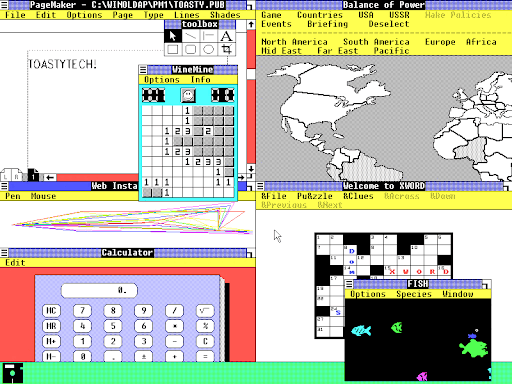
Windows 1.0x Interface
|
Despite criticism, Windows 1.0 proved an important success for Microsoft, as it introduced the Microsoft line of Windows.On December 31, 2001 Microsoft declared Windows 1.0 obsolete and stopped providing support and updates for the system.Windows 1.01 was released in the United States on November 20, 1985, while the European version was released as Windows 1.02 in January 1986. Windows 1.0 offers limited multitasking for existing MS-DOS programs and focuses on creating an interaction paradigm (refer to message loops), a stable implementation model and API for native programs for the future. Due to Microsoft's extensive support for backwards compatibility, it is not only possible to implement the Windows 1.0 binary program on the current (even if only 32-bit) version of Windows on a large scale, but also to rearrange their source code into "the same modern functional applications with only limited modifications.
Windows 1.0 is often considered the "front-end to the MS-DOS operating system", a description that has also been used on versions of Windows that next. Windows 1.0 is an MS-DOS program. Windows 1.0 programs can call MS-DOS functions and GUI programs run from the same .exe file such as MS-DOS programs. However, Windows .exe files have their own 'New Executable' (NE) file format, which only can processed by Windows and, for example, allows the loading of code and data requests. Applications are supposed to handle memory only through Windows itself is a memory management system, which implements a software -based virtual memory scheme that allows applications larger than RAM available.
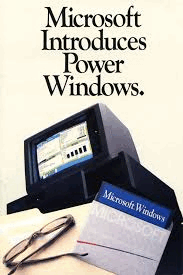
Windows 1.0 Advertisement
in 1985
|
Because graphics support in MS-DOS is very limited, MS-DOS applications need to go to blank hardware (or sometimes just to the BIOS) to complete the work. Thus, Windows 1.0 includes original device drivers for video cards, mice, keyboards, printers and serial communication, and applications should only use APIs built on these drives. However, this is extended to other APIs such as functionality file system management. In this sense, Windows 1.0 is designed to be extended into the operating system completely, not just the graphical environment used by the application. Indeed, Windows 1.0 is 'DOS front' and cannot operate without a DOS environment (it uses, for example, file handling functions provided by DOS).
The level of replacement increases in the next version. Requirements system for Windows 1.01 form CGA / HGC / EGA (listed as "Monochrome or color monitor"), MS-DOS 2.0, 256 KB of memory or more large, and two dual -face disk drives or hard drives. Starting with version 1.03, support for Tandy and AT&T graphics modes has been added. Windows 1.0 runs a shell program called MS-DOS Executive, which does little more than output a DIR command mouse supports icons and does not comply with Y2K. Other programs provided are Calculator, Calendar, Clipboard Viewer, Clock, Notepad, Paint, Reversion, Card File, Terminal and Write. Windows 1.0 does not allow overlapping windows. Instead all the windows are tiled. Only dialog boxes can appear in other windows, but cannot be minimized.
|
You have reached the end of this page.
|
|